
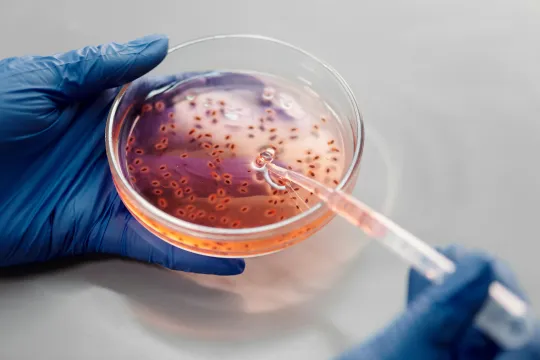
Can We Use Bacteria to Make Renewable Rocket Fuel?
Provided by: Science Journal for Kids|Published on: May 28, 2025
Grades: 3, 4, 5, 6, 7, 8
Type: Scientific Reports
Subjects: Engineering
Authors: Science Journal for Kids
Region: Global
Languages: English, Spanish
This resource has been reviewed by SubjectToClimate's climate scientists and verified for scientific accuracy and up-to-date information. Learn about our review process →
This resource has been reviewed by SubjectToClimate's climate scientists and verified for scientific accuracy and up-to-date information. Learn about our review process →
Synopsis
- This resource from Science Journal for Kids features a scientific article about the potential use of bacteria to create peristent organic pollutants (POPs) to use as rocket fuel, written at student-friendly reading levels.
- The resource also includes a worksheet to assess student understanding, a teacher answer key, videos, and other resources teachers can use to create a lesson based on this article and its topics.
Teaching Materials
Positives
- This article does a great job of introducing the structure of a scientific report to young students in a kid-friendly format.
- The conclusion includes actions students can take to help with the climate change crisis, which may comfort and empower some students.
- At the bottom of the webpage, there are read-alouds of the article available in English and Spanish.
Prerequisites
- Teachers will need to enter some information about their school to access the teacher keys.
- Though the link between fossil fuels and climate change is briefly covered in the article, it may benefit students to have had a dedicated lesson on this topic before reading the article.
- The link for the National Geographic resource goes to a different page, not the one on fossil fuels indicated in the resource.
- You may need to spend time defining persistent organic pollutants for students and provide some examples to discuss, such as DDT, PCBs, and dioxins.
Differentiation & Implementation
- The main article is written for grades 3-5. The resource also includes an article for upper reading levels which can be used for middle school students or high school students who need more scaffolding towards reading a full scientific report.
- Teachers can introduce the glossary terms ahead of time, creating a word wall for students to refer back to throughout the reading. Teachers can also incorporate movement when introducing these terms to support English language learners.
- After reading the section about strong molecules, teachers can incorporate a break for hands-on interaction by providing students with straws and asking them to bend the straws into triangle shapes, as described in the text.
- After reading the conclusion section, students can take a notebook or clipboard around the room to record all the plastics they can find. After independent or team exploration, students can come together to create a master list of what they found. Students can then discuss ways to reduce classroom plastic.
- Challenge students to think about the negative side effects of certain inventions or innovations that may seem to be a good solution to help with one problem, but may cause a problem that is as bad or worse.
- For example, have students investigate CFCs as a solution for keeping homes, cars, and food cool (preventing food spoilage and making homes and automobiles safer in the heat), which also caused the hole in the ozone.
- Another related example includes the replacement CFC chemicals that are extremely powerful greenhouse gases.
This resource from Science Journal for Kids introduces students to the idea of using bacteria to create renewable rocket fuel. It is based on a peer-reviewed research study and is adapted for a middle and high school audience. The resource includes a simplified explanation of the scientific methods, data visuals, and real-world applications of the research. A comprehension quiz and a glossary are also provided to support classroom use. Overall, this article is a valuable tool for teaching students about renewable energy.
Teaching Tips
Standards
Resource Type and Format
About the Partner Provider
Science Journal for Kids
Hundreds of scientific articles. Written for kids. Approved by scientists. Free.
Scientist Reviewed
This resource has been reviewed by SubjectToClimate's climate scientists and verified for scientific accuracy and up-to-date information. Our review process ensures that every resource in our library reflects the current state of climate science.
Learn about our review process →