
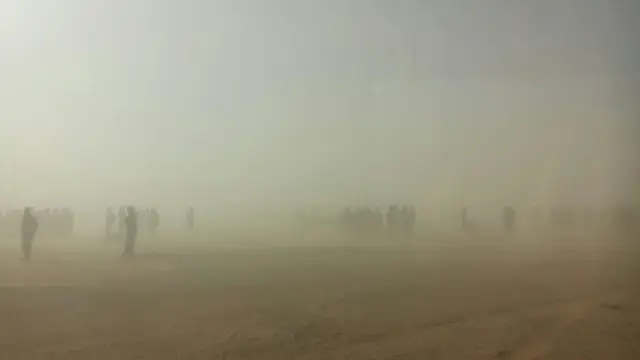
Why Do Some Cities Have Dust Storms?
Provided by: National Science Teaching Association|Published on: May 8, 2026
Grades: 6, 7, 8
Type: Lesson Plans
Subjects: Earth and Space Sciences, Geography
Authors: National Science Teaching Association
Region: Global, California, Alabama
Languages: English
This resource has been reviewed by SubjectToClimate's climate scientists and verified for scientific accuracy and up-to-date information. Learn about our review process →
This resource has been reviewed by SubjectToClimate's climate scientists and verified for scientific accuracy and up-to-date information. Learn about our review process →
Synopsis
- In this lesson, students will look at two cities to determine why one experiences dust storms and the other does not.
- Students will analyze maps to build a model that can predict which cities will experience dust storms, watch a 10-minute video about dust storms, and consider how dust storms are becoming more frequent.
Teaching Materials
Preparation:
- Teachers can access the PDF of the community activity and discussion guide here.
Prerequisites:
- Use this lesson after students have had a unit or lesson on extreme weather and natural hazards. Consider using this lesson plan.
- Review map reading, including latitude, longitude, and map keys.
Interdisciplinary Connections:
- Health:
- Have students consider the health impacts of dust storms, discussed from 7:00-7:46 in the video, and come up with a community action plan to inform communities about the risks and necessary precautions.
- Career Exploration:
- Play the clip where the scientist talks about his entry point into a science career (4:46-5:20). Have students consider if they may have a similar entry point to science as a career.
Differentiation:
- Provide students with pre-labeled maps and partially completed data tables.
This lesson and associated activities explore why dust storms occur in some places, and not others. While exploring this question, students will learn about the factors that impact and drive an area's weather and climate, wind, weather phenomena, and how climate change is affecting dust storms. Students will also gain experience analyzing weather data on maps. The information presented is accurate, and this resource is recommended for teaching.
Teaching Tips
Standards
Resource Type and Format
Scientist Reviewed
This resource has been reviewed by SubjectToClimate's climate scientists and verified for scientific accuracy and up-to-date information. Our review process ensures that every resource in our library reflects the current state of climate science.
Learn about our review process →